Designing First-Person Cinematics for a Story-Driven FPS
Note: This case study focuses on design approach and overall process. All techniques described are high-level and do not reflect proprietary implementation. Details have been generalized to respect project confidentiality.
Keywords
Cinematics, Cinematic Direction, First-Person Cinematics
Overview
For this story-driven FPS project, I worked on defining how cinematics function in first-person.
Instead of treating cinematics as isolated moments, the focus was on building a consistent approach that could support storytelling while keeping the player physically present in the experience.
This required creating a shared cinematic framework that designers, animators, and tech could all use when building and implementing cinematic sequences across the game.
Challenge
First-person cinematics come with a different set of constraints compared to traditional cinematic systems.
While framing, pacing, and performance still need to be controlled, the player remains inside the camera at all times. Standard cinematic techniques, like hard cuts or fully controlled camera sequences, often result in:
- A reduced sense of player presence.
- A “floating camera” feel.
- Breaking the immersion.
The main challenge was finding ways to direct cinematic intent without removing the player from the experience or undermining immersion.
My Role
As a Senior Narrative Designer on this project, I was responsible for:
- Defining and pitching the overall cinematic approach.
- Translating that approach into a usable production framework for the team.
- Supporting the design of cinematic sequences.
- Collaborating with tech to support camera behavior.
- Supporting performance capture direction.
Understanding What Works
To kick off the work, I analyzed how other narrative-driven FPS games approached first-person cinematics.
This involved breaking down their cutscenes and other cinematic elements frame by frame, focusing on:
- How player attention was directed.
- How camera movement and staging supported narrative clarity.
- Where immersion was maintained or broken.
All of this was documented on a whiteboard that the rest of the team could access. It looked something like this:
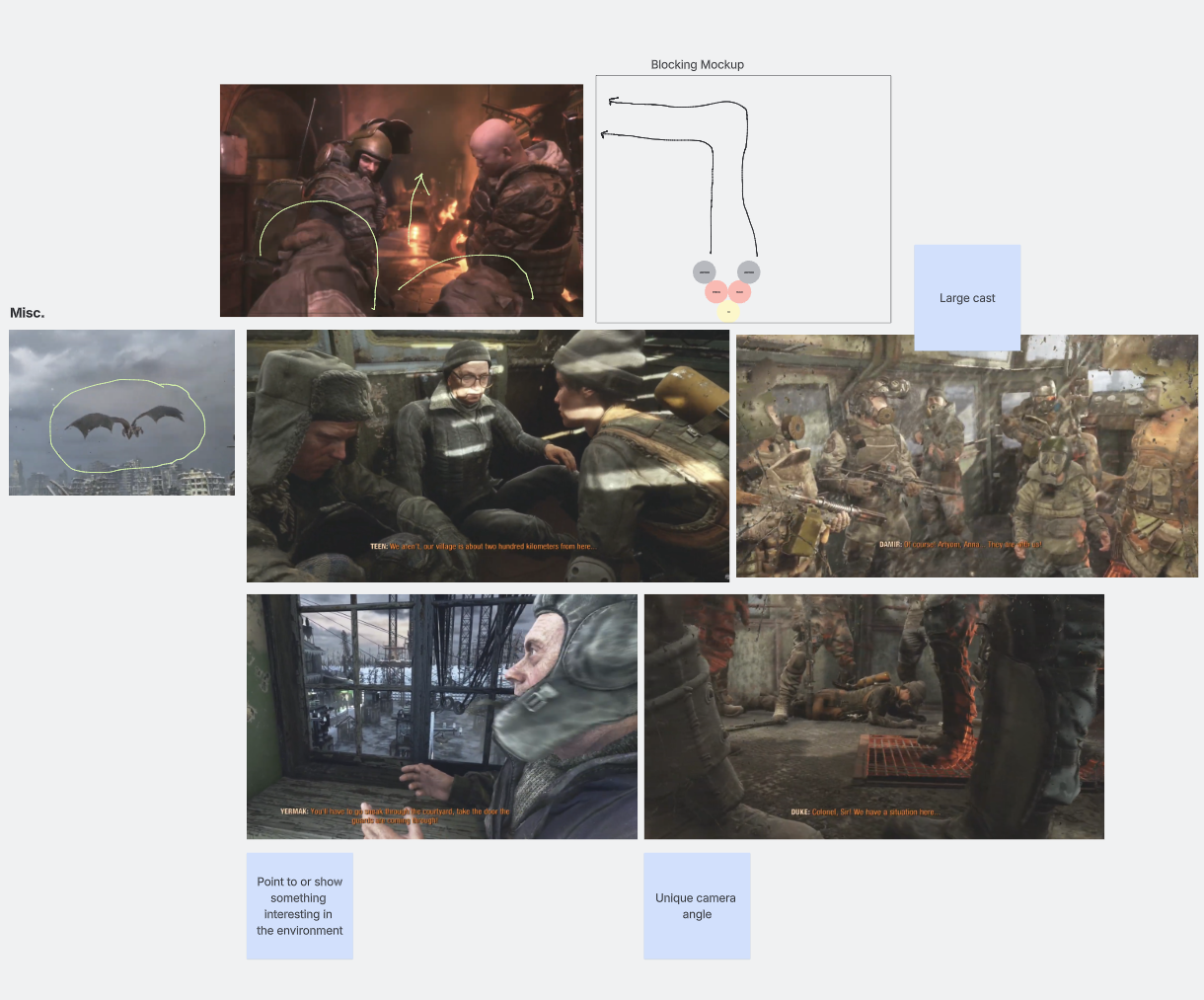
A few patterns emerged from this analysis:
- Players disengage quickly when visual information remains static.
- Small, subtle body movements from both the NPCs and the player-character help maintain presence.
- Hard cuts tend to disrupt immersion in first-person.
- Camera behavior and staging must work together to guide the viewer's attention.
These insights formed the foundation for the cinematic approach used across the project.
Building the Approach
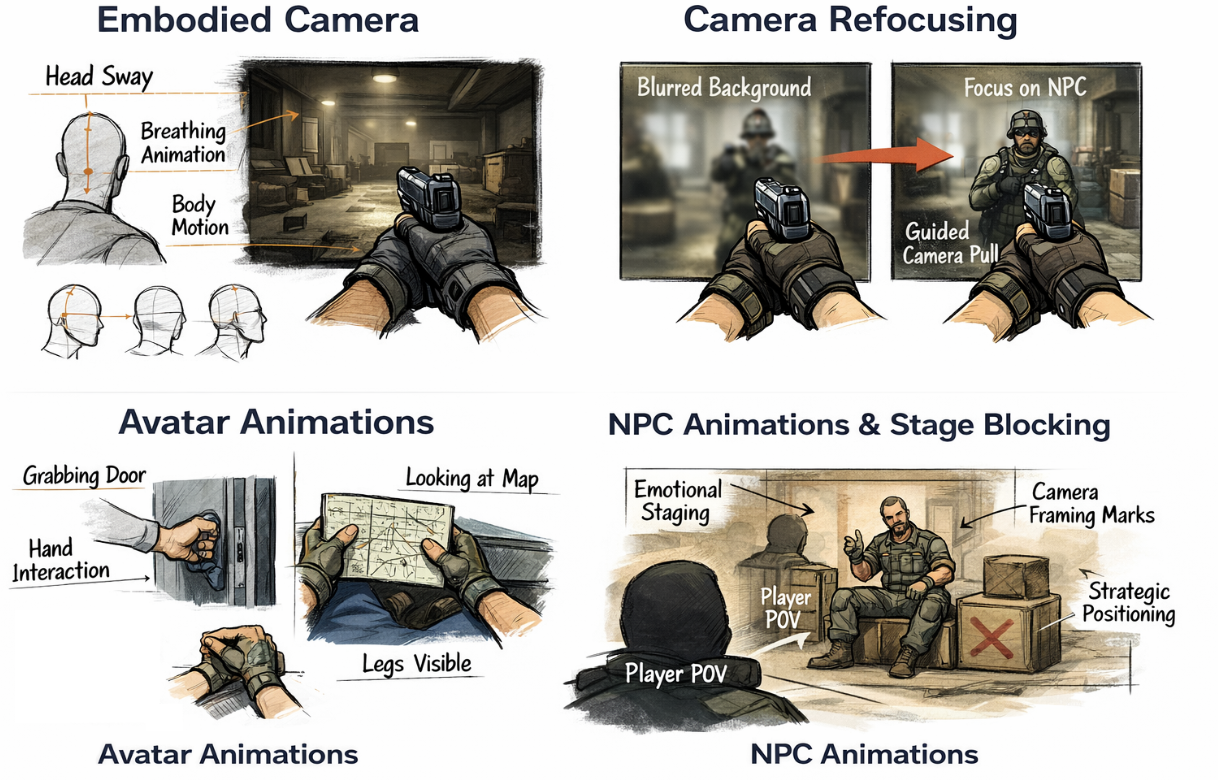
To make these findings usable in production, I translated them into a set of principles that defined how first-person cinematics were built and implemented. These principles were:
- Embodied Camera.
- Directing Attention.
- Avatar Animations.
- NPC Animations and Stage Blocking.
Embodied Camera
The camera was treated as an extension of the player’s body rather than a detached cinematic tool.
This meant accounting for:
- Subtle head movement and sway.
- Shoulder and torso alignment.
- Breathing and micro-adjustments
The goal was to maintain the player's physical presence in the world, even during more directed cinematic moments.
A good example of how an embodied camera approach makes a film more immersive is Hardcore Henry (2016). Here, the camera basically becomes the main character.
The film fully commits to a first-person perspective, with movement and action framed as if experienced directly through the character’s eyes. Every hit and motion feels immediate and physical.
The clip below is pretty intense, but demonstrates how the camera remains tightly anchored to Henry’s head and body. It doesn’t float around like a typical film camera. It moves with him, reacts with him, and stays grounded in his physical space.
Directing Attention
Instead of relying on cuts, attention was guided through movement and composition.
This included:
- Camera pulls toward points of interest.
- Using depth, staging, and framing to guide focus.
- Reframing through motion rather than camera cuts.
The cutscenes in Metro: Exodus (2019, 4A Games) are a great example of first-person cinematics that use this principle successfully.
In the clip below, you can see how the camera shifts focus, moving attention from Anna to other points of interest.
It's a simple but effective technique: these small moments of refocusing help direct attention and control pacing, while still maintaining a natural, immersive first-person perspective.
Avatar Animations
First-person body animation was key in reinforcing presence.
This included:
- Hand and arm movement during interactions.
- Contextual reactions to events.
- Environmental and reactive feedback.
Like Metro: Exodus, Alien: Rogue Incursion (2024, Survios) also makes strong use of first-person cinematics. The clip below shows how the avatar’s animations make Zula feel more present and believable. This is how we aimed to use first-person animations, too.
NPC Animations and Stage Blocking
NPC animation and positioning were designed alongside camera behavior.
This ensured that cinematic readability did not rely on removing control from the player, but instead on composition and staging working together with camera motion.
A good example of how character blocking helps guide the camera’s focus is the “Meet Elizabeth” scene in BioShock Infinite (2013, 2K). Elizabeth works really well as a visual anchor for the camera, which keeps things from feeling static or boring. The clip also does a nice job showing embodied camera movement and other principles described above.
Cinematic Language
Each principle described above addressed a different aspect of maintaining presence and directing attention in first-person: from treating the camera as part of the player’s body, to using animation and staging to support clarity without taking control away.
Together, these elements created a shared cinematic language used across the project. They ensured that every scene followed the same underlying rules for camera behavior, animation, and staging.
Defining this language was only part of the work, though. The next step was understanding how much control the player should retain within cinematics, and how pacing needed to adapt when traditional cinematic tools like cuts were no longer available.
Pacing and Player Agency
We also had to address pacing and player agency. First-person cinematics are especially sensitive to pacing, since you can’t rely on traditional cuts for variation. This required us to create strict rules for designing the cinematics.
To maintain rhythm:
- Scenes were structured around regular attention shifts. Each attention shift happened at a predictable interval of X seconds or X minutes.
- Camera movement and staging changes were used to refresh focus.
- Visual variety came from animation and spatial changes.
Even in more directed moments:
- Players retained limited camera control.
- Small interactions were used to prevent passive viewing.
- Transitions between gameplay and cinematics were kept minimal.
This helped maintain the feeling that the player was always part of the scene.
Outcome
Using the principles and rules above resulted in:
- A consistent cinematic language across the game.
- A framework usable by non-specialist designers.
- Better alignment between narrative, animation, production, and tech.
- Stronger player presence during cinematic moments.
Takeaways
- First-person cinematics rely on a different kind of control.
- Player presence is sensitive. It depends on small things like movement and how the body feels in the game space.
- A shared cinematic language helps different teams stay consistent across all scenes.
- Good first-person direction results in scenes that feel natural to the player.