Where the Story Lives: Building Narrative Vehicles in AAA VR
Note: Project details and names have been generalized or fictionalized to respect project confidentiality.
Keywords
Narrative Design, Script Formatting, Narrative Processes, Narrative Vehicles
Overview
In my experience across projects, one thing consistently emerges as the most important step in my narrative design process: define your narrative vehicles (!!!).
Before writing a single line of dialogue or planning a quest structure, it’s important to understand how your story is being communicated to the player.
When I joined Vertigo Studios Amsterdam on their unannounced AAA VR title, defining the narrative vehicles became a core part of my role. The script, content, tools, and designers were already there, but we still needed a unifying framework to connect them and support a scalable narrative implementation.
Challenge
The main challenge in this project was translating the narrative into a production-ready form. While the script covered all story content, there was room for improvement in how it was implemented and integrated into day-to-day workflows across disciplines, which made execution and alignment more difficult.
This also meant that:
- We needed more clarity on ownership across narrative elements.
- We needed more precision in scoping narrative work, especially when breaking content into deliverables.
- We needed a more consistent structure to connect design intent with production needs.
- We needed a shared framework to turn the script into something actionable for the entire team.
My Role
In this project, I was responsible for:
- Establishing narrative frameworks for content development.
- Defining quality standards for narrative content, dialogue writing and editing.
- Coordinating narrative design processes across disciplines.
- Aligning with creative direction and leadership on narrative content.
- Maintaining narrative consistency across all departments.
What are Narrative Vehicles?
Narrative vehicles are the main channels through which a game tells its story (think: VO, cutscenes, items, environmental storytelling, and so on). Most games don’t rely on just one vehicle. You usually end up with a mix, depending on the game's design, genre, and tone.
For example:
In Superfuse (ARPG), the main narrative vehicle was NPC dialogue, primarily in hub spaces and quest interactions. That’s where the core story lived and was delivered directly.
In this preview of Superfuse, you can notice how the story is delivered through comic-book–style NPC speech bubbles, which are built right into the game’s quest mechanics.
In PUBG: Black Budget (extraction shooter), the narrative moves away from traditional dialogue-heavy storytelling, so the design leans much more into environmental storytelling, systems, and quests.
Have a look at this playthrough of PUBG: Black Budget and notice how the game’s narrative is experienced through the world itself, rather than traditional storytelling techniques.
Overall, because they sit in different genres with different design philosophies and core gameplay systems, Superfuse and PUBG: Black Budget would naturally be expected to require different narrative approaches (i.e., different narrative vehicles), which in turn would lead to different implementation and production approaches.
Why Do Narrative Vehicles Matter?
Narrative vehicles form the foundation of your narrative design philosophy, pipelines, and implementation strategy.
Once defined, they allow you to move from abstract story ideas to concrete production planning.
They answer important questions such as:
- How is the story experienced moment-to-moment?
- Which team owns which part of the narrative delivery?
- How do narrative elements integrate into production workflows?
Without that clarity, narrative work tends to get scattered across disciplines without a shared frame of reference.
I will demonstrate how this worked in Project Vault.
Note: Project Vault is a fictional name used for confidentiality purposes and does not reflect any internal project title.
Example: Building Narrative Vehicles in Project Vault
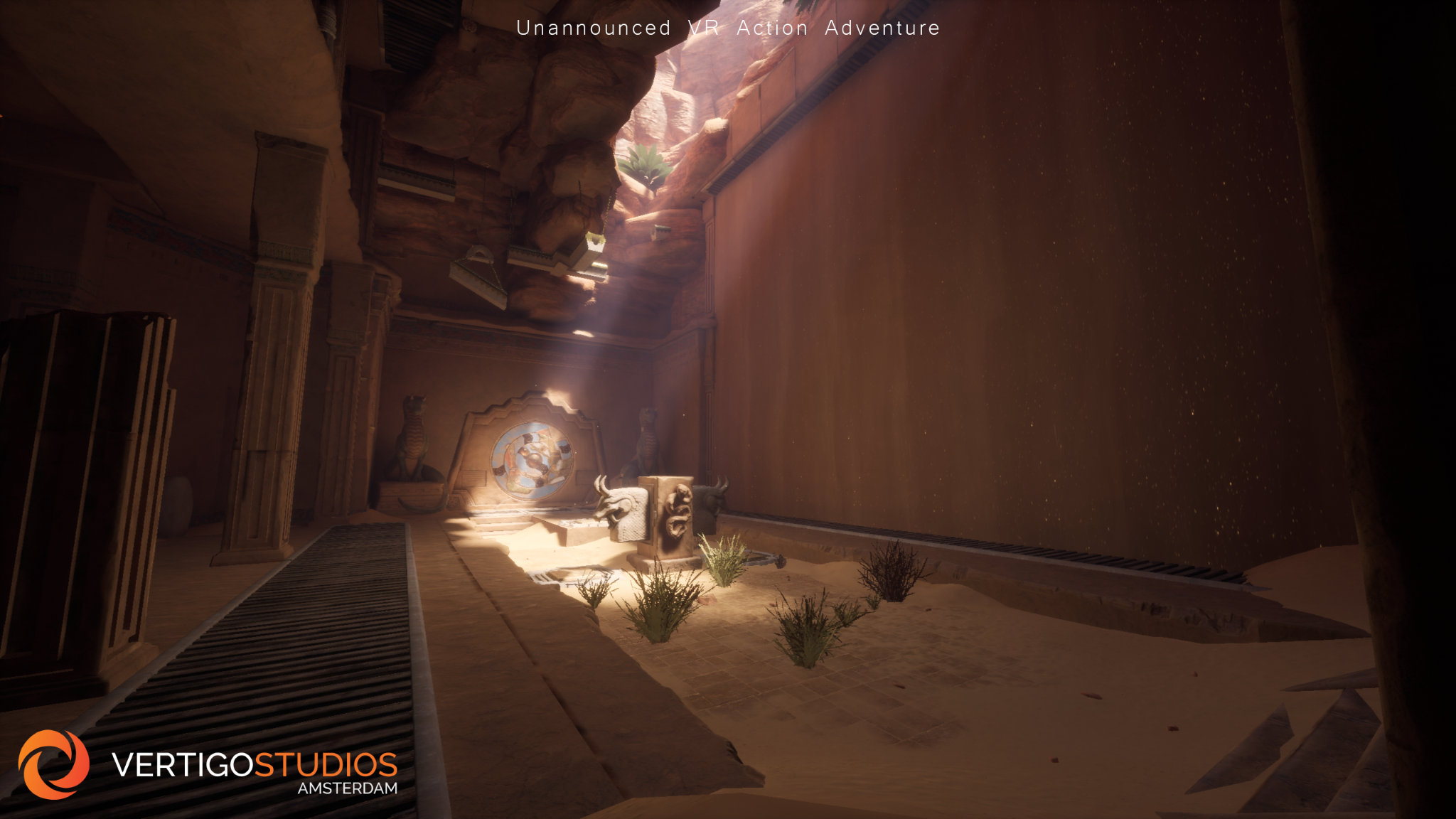
When I first joined the project, I looked at how the team was handling narrative:
- Is there a clear understanding of the narrative vehicles?
- Is there a shared overview of them?
- Are they actually reflected in the production pipeline?
- And how is narrative being implemented day to day?
In Project Vault, there was already a solid base, but it needed clearer a structure. So one of my early tasks was aligning and structuring the narrative vehicles so the team could operate from a shared mental model. Once defined, the narrative vehicles became a standard across the project.
A key part of the process was making sure the framework was applied consistently across disciplines. Where edge cases or overlaps came up, I helped clarify how elements should be categorized so the system stayed clear and usable as it moved through production.
Working With the Script
Project Vault used a script as the central narrative backbone. That script covered everything from VO and environmental storytelling to barks and cinematic moments.
The challenge was that a script alone doesn’t always translate cleanly into production, especially in a game where different narrative vehicles are handled by different disciplines.
So we had to reshape how we used it.
Breaking the Script Into Narrative Vehicles
After defining the narrative vehicles used in the project, together with the narrative team I reviewed the script and mapped out its contents to different narrative vehicles.
We mapped things like:
- Where does VO occur?
- Where does environmental storytelling occur?
- Where do systemic narrative elements like barks or objective text appear?
It was meticulous, but it quickly changed how we saw and used the script.
Here's an example of how this looked in practice.
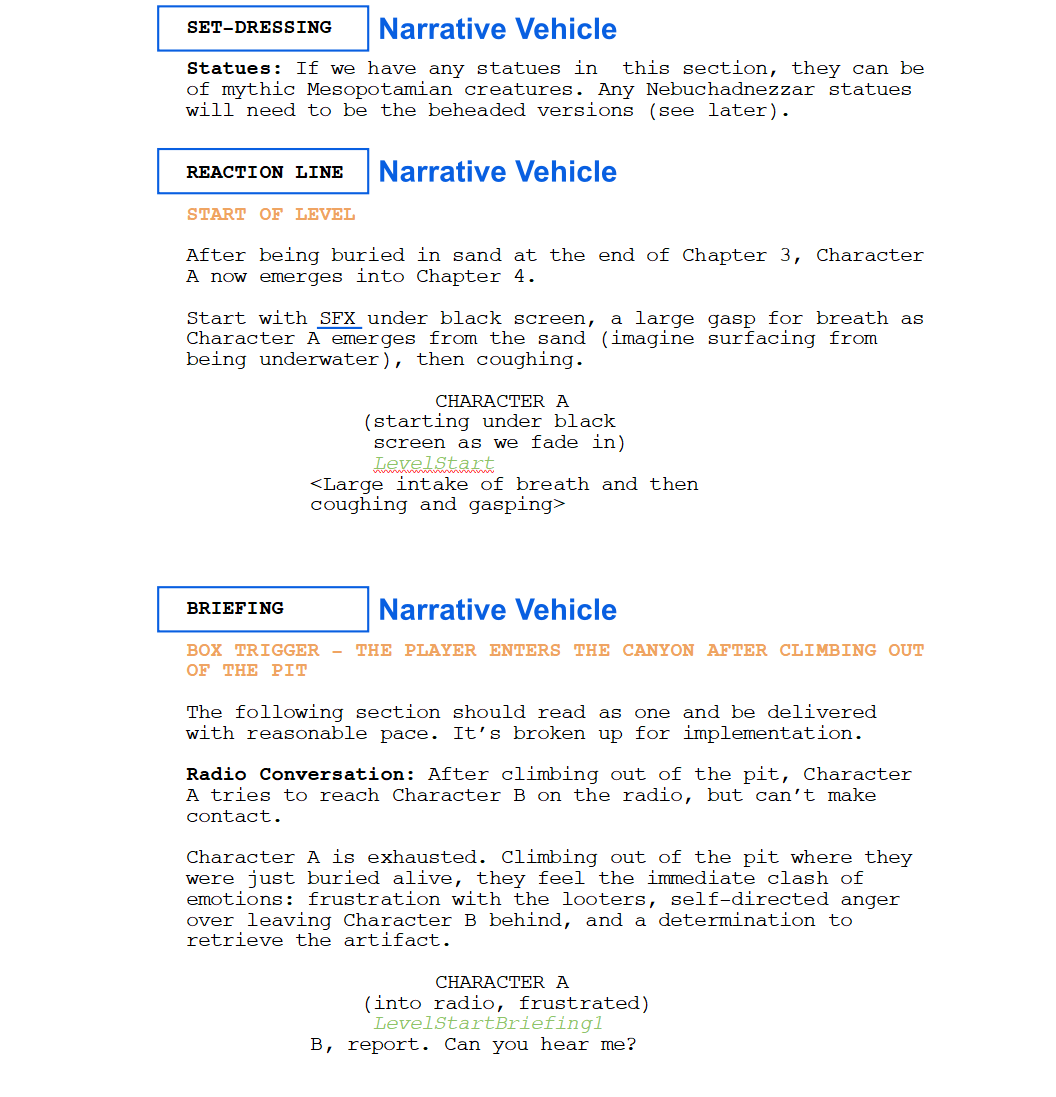
We tagged each element in the script to indicate which narrative vehicle it belonged to. Occasionally, an element combined one or two vehicles, like a Reaction Line paired with an SFX. In those cases, we grouped them under a single vehicle to keep the script consistent and clean. When we later pulled everything into an Excel sheet or asset overview, we made sure those details were captured there. Situations like this were rare, though.
Impact on Production and Collaboration
This approach had immediate and practical benefits:
- It allowed scoping narrative assets per chapter much more accurately (VO, art needs, etc.).
- It provided clearer direction to level designers and artists about where narrative should show up and what form it should take.
- It enabled better task distribution within the narrative team, making ownership of different narrative vehicles explicit.
- And overall, it gave production a much clearer picture of what “narrative work” actually meant in practice, not just in theory.
From Process to Pipeline
Over time, this stopped being just a one-off exercise and became a working pipeline.
Once narrative vehicles were properly defined and consistently used, they acted as a shared language between narrative, design, and production.
And that’s really the main value of narrative vehicles: not the terminology itself, but the fact that everyone can look at the same game and understand how the story is meant to live inside it.
Ensuring consistency became an ongoing responsibility, making sure the framework stayed intact as it moved through different disciplines and stages of production, rather than fragmenting or drifting in interpretation over time.
Takeaways
- Start with narrative vehicles, because they define how your game actually communicates story to the player.
- They shape everything downstream, from narrative design decisions to production pipelines and implementation.
- Every game uses a different mix of vehicles, depending on its genre, structure, and storytelling needs.
- A script alone isn’t enough for production, it needs to be translated into actionable narrative structures.
- Mapping narrative vehicles brings clarity by making scope, ownership, and content needs explicit.
- It improves cross-discipline communication by giving everyone a shared language for narrative delivery.
- With consistency, narrative vehicles can evolve from a design concept into a fully functional production pipeline.